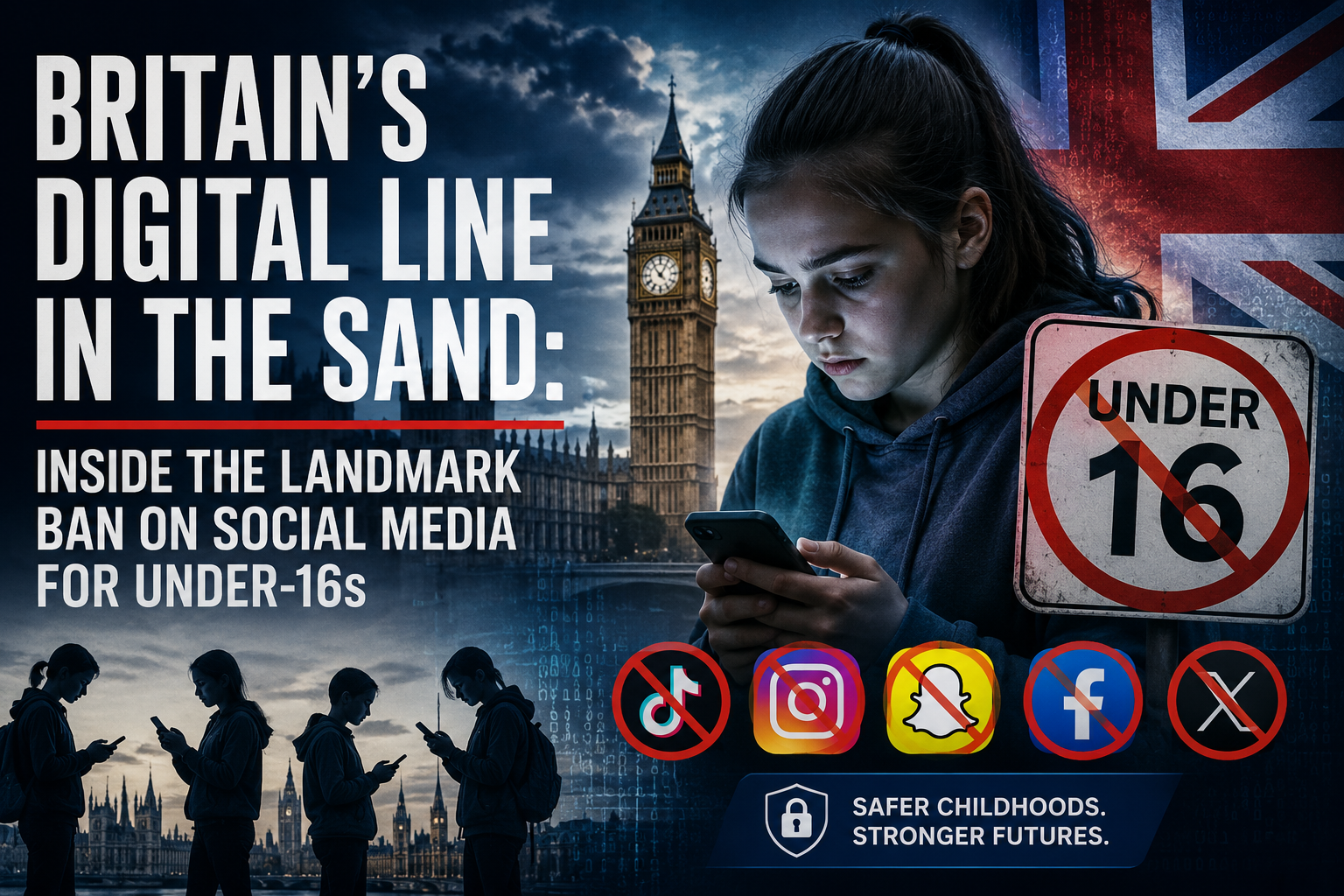

Britain’s Digital Line in the Sand: Inside the Landmark Ban on Social Media for Under-16s
On June 15, 2026, British Prime Minister Keir Starmer announced a seismic shift in the digital landscape, unveiling plans to ban children under the age of 16 from social media. In a move that goes further than similar legislation in Australia, the UK government is positioning this not merely as a regulation, but as a cultural intervention to "give kids their childhood back".
The announcement, which followed a public consultation garnering over 116,000 responses, represents one of the most aggressive crackdowns on Big Tech to date. As the government prepares to implement the ban by Spring 2027, the nation finds itself divided between parents desperate for relief, tech giants facing an existential threat to their user bases, and experts questioning whether a ban is a silver bullet or a simplistic scapegoat.
The Details of the Ban
The proposed legislation will bar users under 16 from accessing "user-to-user" platforms designed for social interaction and driven by algorithms. This explicitly includes major players such as TikTok, Instagram, Facebook, X (formerly Twitter), Snapchat, and YouTube . Unlike Australia’s model, the UK ban will specifically exempt messaging services like WhatsApp and Signal, recognizing their function as private communication tools rather than public content broadcasting .
However, the government is not stopping at a simple age restriction. In an effort to close loopholes, the ban will also target harmful functionalities on a wider range of services, including gaming sites. Features such as livestreaming and the ability for strangers to contact minors will be blocked by default for under-16s—and even for 17-year-olds, to prevent a "cliff-edge" drop in protections .
Furthermore, the UK is taking aim at the burgeoning field of AI. So-called "romantic companion" chatbots, which simulate sexual relationships, will be strictly limited to users over 18 .
The Rationale: A Crisis of Childhood
For the Labour government led by Keir Starmer, the ban is a response to what they see as a public health emergency. The Prime Minister framed the decision as a choice between "families across the country, or a status quo that isn’t working" .
The statistics driving this resolve are stark. The government’s consultation revealed that 9 out of 10 parents support a ban, citing the erosion of mental health and the dangers of exposure to predators and harmful content. Health professionals on the front lines have echoed this urgency. Dr. Rebecca Foljambe, a GP in Yorkshire, noted that it is now "commonplace to be wrestling a smartphone or an iPad out of a toddler's hand," arguing that social media "sets children up to fail" by exacerbating mental illness.
The government argues that current safeguards are insufficient. Despite platforms having a nominal age limit of 13, Ofcom reports that 82% of 10-to-12-year-olds are already using social media. By raising the age to 16 and enforcing it through "highly effective age assurance" measures, the government hopes to create a new social norm where access is the exception, not the expectation.
The Opposition: "A Lazy Cop-Out"
Despite the political popularity of the ban, it has faced immediate and forceful pushback from child development experts, digital rights campaigners, and even some teenagers.
The most prominent criticism comes from academics like Professor Sonia Livingstone of the London School of Economics. Writing in January 2026, before the final draft was passed, Livingstone warned that the government was rushing into a policy without evidence that bans actually work. She points out that Australia terminated 4.7 million children’s accounts in December 2025, but there is no data yet to prove those children are happier, safer, or whether they simply migrated to darker, unregulated corners of the internet using VPNs.
Critics argue the ban addresses the symptom rather than the disease. "Putting a ban on things is a lazy cop-out from the government," said Shannon Alexandra, an influencer who started her business at 14. She argues that the focus should be on prosecuting predators and forcing platforms to change their abusive algorithms, rather than punishing young users.
There is also concern about the social cost for vulnerable youth. Charities working with LGBTQ+ children or those in minority ethnic communities note that for many isolated teens, social media is the only place they can find identity peer support. Megan Hinton of the Marie Collins Foundation warned that a ban cuts off these lifelines, pushing children toward "less visible and less regulated spaces".
Even teenagers themselves have expressed anxiety about the loneliness a ban might cause, with 72% of child respondents to the government’s own consultation admitting they were worried about "feeling left out".
Implementation and Enforcement: The 2027 Target
The government has set an aggressive timeline. Utilizing powers granted by the Children’s Wellbeing and Schools Act, ministers plan to bring the regulations to Parliament before Christmas 2026, with the protections expected to come into force in Spring 2027.
However, enforcement remains the trillion-dollar question. Currently, the de facto ban for under-13s is routinely bypassed. To succeed where previous efforts failed, the UK will rely on "highly effective age assurance" technology. This could involve facial age estimation, government ID checks, or bank verification. The government is also looking at introducing overnight curfews and breaks for infinite scrolling for those under 18 to further limit exposure.
The geopolitical stakes are also high. The ban risks inflaming tensions with the United States, where the Trump administration has warned that such regulations impose "disproportionate compliance burdens on American companies" and could violate free speech principles.
Conclusion
The UK’s ban on social media for under-16s is a landmark experiment in digital parenting. For the millions of parents who feel they are fighting a losing battle against algorithms designed to capture their children's attention, the ban offers a legislative shield.
Yet, as Culture Secretary Lisa Nandy admitted, the ban on its own is "not the silver bullet solution". History suggests that prohibition without robust education and alternative opportunities often fails. The success of this policy will not be measured by the date it passes in Parliament, but by whether, in 2030, British teenagers have truly reclaimed their childhood—or merely found new ways to log on.
Disclaimer : Above article is compiled as per the Online articles